Sol AI
A digital twin of every system you've installed.
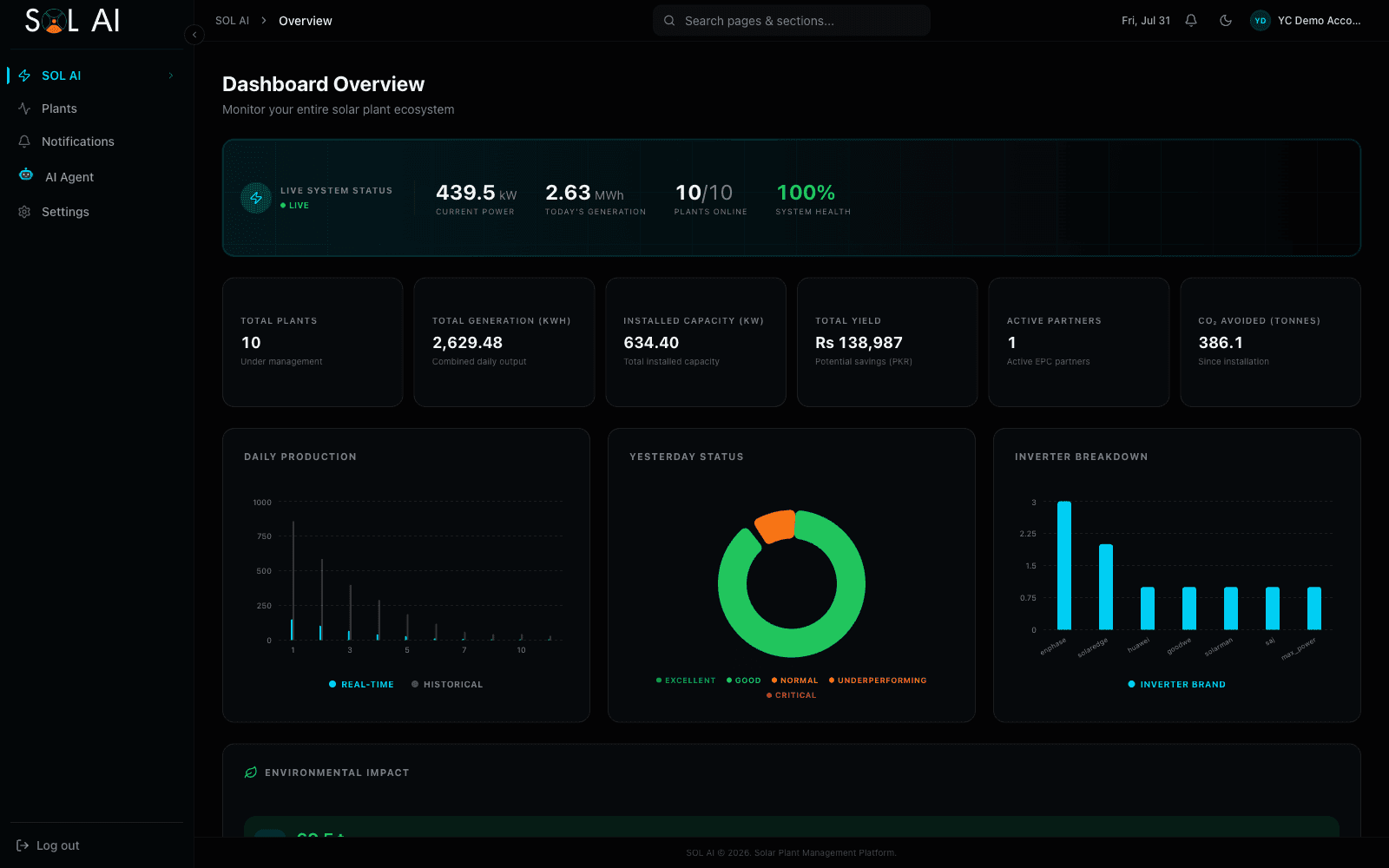
One dashboard for every brand. Weather-adjusted expected output per site, per string — faults classified with a dollar figure attached, and homeowners told in plain language. Turn your install base into $15–25/month care plans; we charge you $1.50/system.
- 464
- Systems
- 13.9 MW
- Capacity
- 9
- Brands
- ~11 min
- Polling
Per string
A baseline, not a green light.
Sol AI computes weather-adjusted expected output for every site and every string, then compares it to what actually arrived. A system can be online, reporting, and still quietly missing a third of its production. That gap is what gets surfaced.
In dollars
Faults classified with money attached.
A fault that reads “string 2 offline” means nothing to a homeowner and little to a dispatcher. Sol AI classifies the fault and attaches what it costs per month, so a truck roll can be ranked against its own payback.
Plain language
Homeowners told what happened.
Every diagnosis has a homeowner-readable version. It is what makes a care plan sellable. The customer sees what you caught and what you fixed, in words they use.
Economics
$15–25/month care plans, at $1.50/system.
Your install base is already the asset. We charge $1.50 per system per month. The spread between that and what a care plan bills is the service business.
Every app showed green. $260 a month was walking out the door.
A 29-kilowatt residential system. One string disconnects. The manufacturer's app: green. Sol AI's baseline: 54 kWh missing every day — roughly $260/month of silent loss the homeowner would never have found. Multiply by every roof you've ever touched. That's the service business hiding inside your install base.
Fleet economics
What your install base is worth.
Care-plan revenue against monitoring cost, on the systems you have already installed.
- $96,000
- Care-plan revenue / year
- $7,200
- Sol AI cost / year (at $1.50/system/mo)
- $88,800
- Net new recurring revenue
400 systems → $96,000/year of care-plan revenue against $7,200/year of Sol AI cost.
See the full calculator and the maths →
Selling the systems in the first place is a different problem. That is AI solar lead response, and the numbers behind both are on our audited proof page.
How it connects
No hardware. No truck roll. No gateway to maintain.
Sol AI connects to each inverter manufacturer's cloud platform through its API, authenticated with an account credential or OAuth token you authorise once per brand. The inverter is already sending its data there; we read the same stream, on your behalf, across every brand at once.
Nothing is installed at a site. No data logger, no gateway, no local network configuration, no second device for a homeowner to unplug during a router reset. Bringing an existing fleet online is a credential exchange rather than a truck roll, which is what makes adopting an orphaned fleet practical at all.
Polling runs at roughly ten minutes on most devices, with a fleet median of 11 minutes measured across 55,268 inter-reading gaps. That is the manufacturers' own cadence. Nothing installed on site would make their cloud publish faster.
What we do not do: we do not speak Modbus TCP, IEC 60870 or OPC UA, and we do not deploy local protocol gateways or SCADA integrations. If you need direct on-site polling of utility-scale plant over an industrial protocol, we are the wrong tool. Better to say so now than during onboarding.
Brand coverage
9 brands read from production today.
We list adapters that are running, not adapters that are planned. An installer who buys on a compatibility claim and finds their fleet unreadable is a refund, and a reference we lose.
- GoodWe
- Sungrow
- Huawei
- Fox
- Solis
- Growatt
- Solarman
- SAJ
- MaxPower
In integration
Enphase and SolarEdge are being built with the founding partner cohort, against their own fleets. They are not live today and we do not count them as supported.
FAQ
Questions, answered
What is Sol AI?
Sol AI is a monitoring platform that builds a digital twin of every solar system an installer has put in, across every inverter brand, in one dashboard. It calculates weather-adjusted expected output per site and per string, classifies faults with a dollar figure attached, and explains them to homeowners in plain language. It currently watches 464 systems totalling 13.9 MW, polled roughly every 11 minutes.
What inverter brands does Sol AI support?
Sol AI reads 9 inverter brands in production today: GoodWe, Sungrow, Huawei, Fox, Solis, Growatt, Solarman, SAJ and MaxPower. Only brands with a working adapter running in production are listed — planned integrations are shown separately and never counted as supported.
Does Sol AI work with Enphase and SolarEdge?
Enphase and SolarEdge are in integration, built together with the founding partner cohort rather than claimed in advance. Founding partners shape those adapters against their own fleets and get them first. They are not live today, and Sol AI does not list them as supported.
Do I need new hardware for Sol AI?
No. Sol AI connects to each inverter manufacturer's cloud platform through its API, using a credential you authorise once per brand. Nothing is installed at a site — no data logger, no gateway, no local network configuration — so bringing an existing fleet online is a credential exchange rather than a truck roll.
What is string-level monitoring and why does it matter?
String-level monitoring reports the output of each individual string of panels rather than only the system total. It matters because a system with one dead string still reports plausible total production and shows no fault, so the failure can persist for months. In one case we documented, a 29 kW system ran with one of three strings disconnected for 22 days while the manufacturer's app showed green — about $260 a month of loss that only appeared when output was compared against a weather-adjusted baseline.
What happens to solar monitoring when an installer goes out of business?
The systems keep producing but nobody is comparing their output against expectation. The homeowner still has the manufacturer's app, which reports what the inverter can see, but no one is watching for the failures that do not announce themselves — a dead string, a failing optimiser, encroaching shade. Because residential monitoring runs through the manufacturer's cloud API, another company can adopt those systems without a site visit.
How do solar installers build recurring revenue?
By selling monitoring and care plans on systems they have already installed, typically $15-25 per home per month. The install base is already paid for, so the only new cost is the monitoring platform — Sol AI charges $1.50 per system per month — and the spread is recurring margin on completed work. A 400-system base at $20 per month is $96,000 a year against $7,200 of cost.
Who is Modular Intelligence?
Modular Intelligence is the company behind Sol AI and Shams, founded by Mujtaba Raza. It was built inside Solar Citizen, a solar installation company operating across 11 cities in Pakistan, and its software has run that company's sales and service end to end since February 2026. It is now bringing the platform to US installers, starting in New York.